
Feel Connected. Speak French with Manaelle.
Dec 5 - Written by Manaelle Nogry
December in Alsace: Where Childhood Magic Never Fades
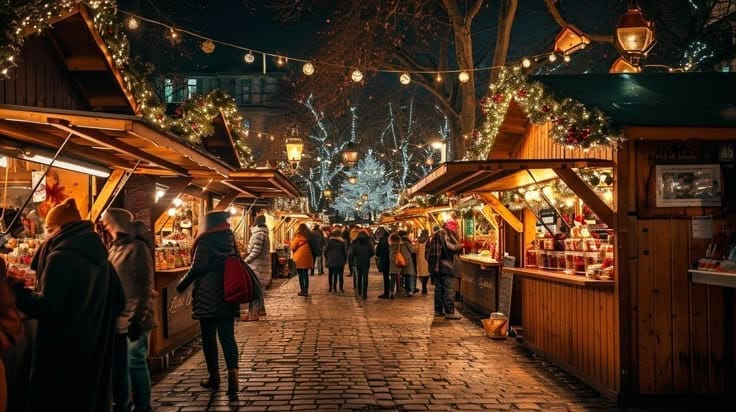
There’s something almost indescribable about the way December arrives in Alsace. It’s as if the whole region exhales at once and shifts into a softer, warmer, dreamier version of itself. Lights appear everywhere, the air smells of spices and oranges, and people suddenly seem lighter, almost as if we all secretly agree to fall back into childhood for a few weeks each year. Even as an adult, I still feel that same spark I felt as a little girl. December in Alsace is made to awaken your inner child — whether you’re ready for it or not.
I still remember that feeling as a child — the excitement that December brought. We knew the Christmas markets were opening, the lights would turn on, and that everything would suddenly look like a fairy tale. My parents would take me to the Colmar Christmas market, where there used to be a giant mailbox for sending your letter to Santa. I’d drop mine inside with so much pride, believing it was traveling straight to the North Pole. That moment always felt like the true beginning of the season.
But nothing says “December in Alsace” like the celebration of Saint Nicolas, one of our most iconic traditions. At school, Saint Nicolas would visit us with a clementine and chocolates… always accompanied by the Père Fouettard, the scary character who kept us in line! We all pretended not to be afraid — but we absolutely were. At home, we’d prepare a huge pot of real hot chocolate — the kind made with chocolate from a local chocolaterie — and we’d dip our manalas, the little brioche men we adore here — or mennele as some say — little brioche-shaped men that are soft, slightly sweet, and usually nature (no added flavours) or studded with chocolate chips. They’re simple, but for us they taste like pure comfort. It’s still one of my favorite traditions as an adult. You have to feed your inner child, right?
And of course, December also means bredeles — the famous Alsatian Christmas cookies that grandparents bake in massive quantities, using recipes passed down from generation to generation. Every family has its own shapes, its own secrets, its own flavors. You eat one, then five, then ten, and nobody judges you — it’s Christmas.
Everything about this season here is tied to the senses. The smell of spices drifting from the markets, the warmth of mulled wine, the gingerbread, the Hoggeï cake, the roasted chestnuts… everything feels familiar and comforting, everything feels like home.
Some of my winter memories also include the cold days when we’d go to La Bresse, Lac Blanc, or Champ du Feu to go sledding or skiing, always ending the day with something warm and hearty — often a pot-au-feu. December was always cold, sometimes snowy, and always delicious.
As I grew older, I started to appreciate the Christmas markets in a different way. Not just as places of magic from my childhood, but as living traditions that connect us to who we are. Ribeauvillé is still my favorite — a medieval Christmas market where the entire town transforms into something out of another era. You can eat soup served in a bread bowl, watch medieval performances, warm up near burning logs, and wander through a place that feels like a historical fairytale. Every year, without exception, I go back.
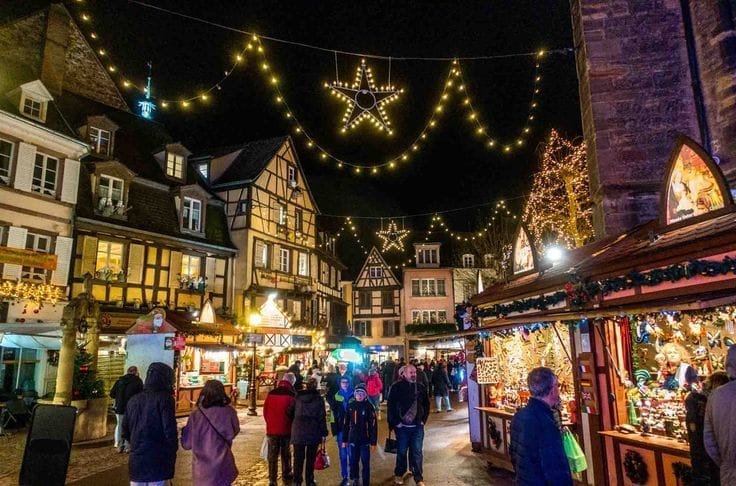
Then there’s Kaysersberg, the market I know best, full of life, smells, laughter, and authenticity. Nothing feels staged — it’s old-fashioned in the best way, and I always get a crêpe there. And of course, Colmar, a classic: beautiful, varied, easy to reach by train, and home to my yearly tradition of grabbing a jus chaud (non-alcoholic gluwhine) Strasbourg is stunning too, especially its enormous Christmas tree, but it has a different, more international feel.
These markets aren’t just pretty places to walk through; they’re part of who we are. They mark the passage of Christmas as surely as the first frost.
And then there’s Christmas Eve — the moment that still feels magical. As children, we’d be told to hide so that Santa could come. We’d run into a room and wait, imagining the sound of bells or footsteps, and when we returned, the gifts were under the tree as if by miracle. The house felt warmer, glowing with lights and anticipation. We’d start the evening with a big apéro — because in Alsace, every celebration begins with apéro — and then we often had raclette for dinner. Simple, comforting, perfect. Dessert was always a frozen yule log, the kind every French child waits for all year. And the next day, no matter how full we were, we’d go outside for the traditional walk — the French “walk off Christmas” ritual.
Even now, as adults, we feel the enchantment of this season. It’s the beauty, the lights, the familiar rituals, the food we grew up with, the chance to pause and share something warm with the people we love. Alsace has a very strong identity — shaped by Germanic influence, religious traditions, its dialect, its history, and its deep love of gastronomy. Christmas brings all of this together. It’s not just decorative; it’s cultural, emotional, deeply meaningful.
If you’re planning to visit Alsace during December, you’ll see the fairy lights, the chalets, the decorations — but you’ll also feel something deeper: a region that truly lives Christmas. And if you want to go even further, to understand not just the language but the traditions, the stories, the way locals experience all of this, that’s exactly what my lessons are built on. I teach French through culture, authenticity, and real-life traditions — the kind that help you feel like you’re not just visiting Alsace, but belonging to it.