
Feel Connected. Speak French with Manaelle.
Feb 5 - Written by Manaelle Nogry
French Celebrations and Public Holidays: Understanding France Through Its Traditions

If you spend some time in France, you’ll quickly notice that the calendar is full of celebrations, public holidays (les jours fériés), and traditions deeply rooted in history, religion, and everyday life. These moments are not just days off — they are part of how French people live, gather, eat, and pass on culture.
Just a few days ago, on February 2nd, we celebrated Candlemas (la Chandeleur) — the perfect example of how traditions continue to live on in simple, delicious ways.
Candlemas (La Chandeleur) – February 2nd
Originally, Candlemas was a religious celebration linked to light and purification (les chandelles). It marked the return of longer days and the end of winter darkness.
Today, in France, it is mostly known as crêpe day.
Families and friends gather to make and eat crêpes (les crêpes), often sweet, sometimes savory. There is even a superstition that says flipping a crêpe while holding a coin brings good luck (la chance). It’s a simple tradition, but one that almost everyone knows and enjoys.
From there, the French year continues with many other important dates.
Major French Public Holidays and Traditions
Easter (Pâques) – March or April
Easter has religious origins, celebrating rebirth and renewal. In France today, it is mostly associated with chocolate (le chocolat).
In France, the Easter tradition centers around the Easter Bunny (le lapin de Pâques) or Easter Hare (le lièvre de Pâques), who — according to local folklore — hides chocolate eggs in gardens.
This means that big egg hunts (la chasse aux œufs) don’t just involve kids — they can become enormous events where everyone, young and old, joins in the fun.
Families gather, chocolate is everywhere, and it feels like spring itself is celebrating.
May 1st – Labour Day (La Fête du Travail)
May 1st is a serious and loved holiday in France, honoring workers’ rights and solidarity. Traditionally, people offer lily of the valley (le muguet) as a symbol of good luck.
In Strasbourg, for example, life stops on May 1st — even the public transport company (la Compagnie des Transports Strasbourgeois, CTS) doesn’t run! Almost nobody works, and most shops and services are closed.
May 8th – Victory in Europe Day (La Victoire 1945)
This day commemorates the end of World War II in Europe. It is marked by official ceremonies, speeches, and remembrance (le devoir de mémoire). For many French people, it’s also simply a quiet day off.
Ascension Day (L’Ascension) – May
A religious holiday celebrated 40 days after Easter. It always falls on a Thursday, and many people take Friday off as well, creating a long weekend known as “faire le pont” — literally “make the bridge” — by taking Friday off as well, creating a long weekend.
Pentecost (La Pentecôte) – May or June
Originally religious, Pentecost Monday is now more controversial. Some people work, others don’t — but culturally, it’s still considered part of the long spring holiday season. While its observance varies, it’s still officially recognized and once again shows how the church calendar has influenced public life in France.
June 21st – Music Day (La Fête de la Musique)
One of the most loved celebrations in France. On this day, music is everywhere — in the streets, bars, parks, and squares. Amateur and professional musicians play for free, and cities turn into open-air festivals.
June 23–24 – Saint John’s Eve (Le Feu de la Saint-Jean)
This is a celebration linked to the summer solstice (le solstice d’été). Traditionally, huge bonfires (les feux) are lit to celebrate light, summer, and community.
In my village, this was always magical: at around 8 p.m., an enormous wooden structure was set alight. There was music, a dance floor, long tables and benches where everyone gathered, tarte flambée (thin Alsatian pizza-like flatbread) and knacks (smoked sausages) were grilled, and both parents and children shared the night. It was about community, summer warmth, laughter, food, and memory.
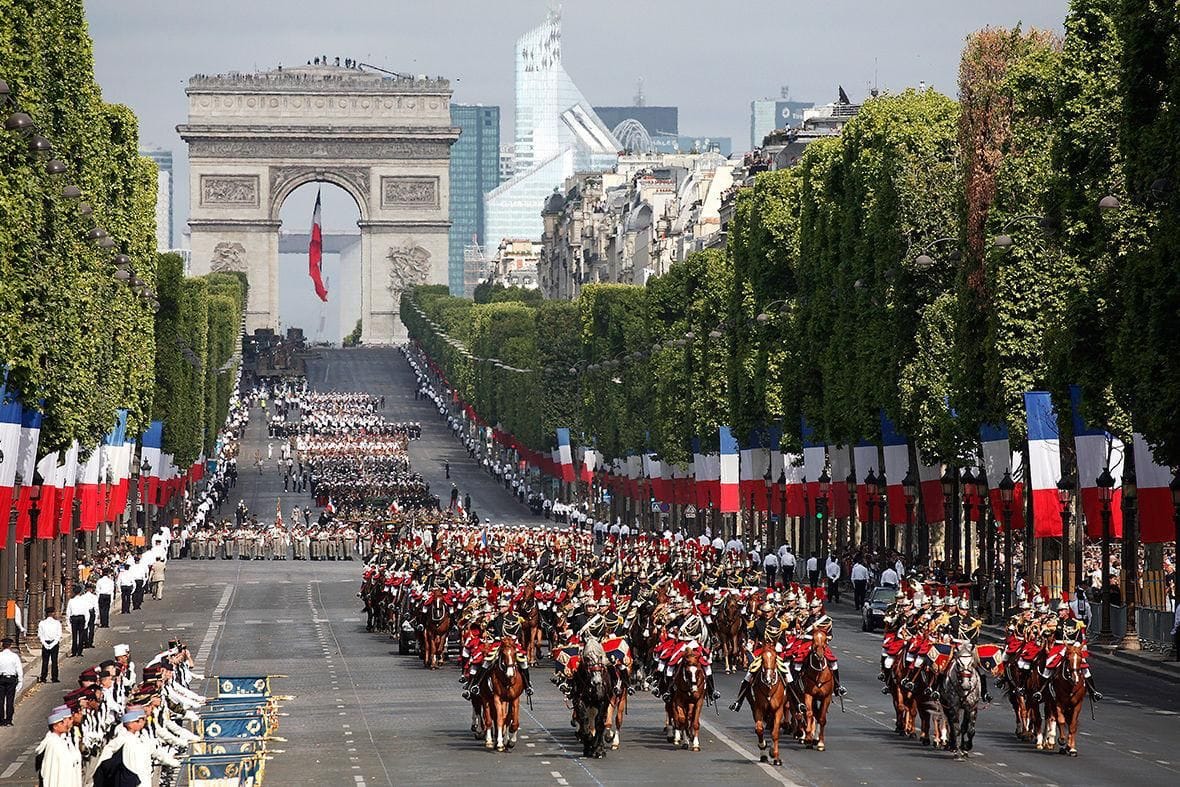
July 14th – Bastille Day (La Fête nationale)
This is France’s national holiday, celebrating the French Revolution of 1789 and the storming of the Bastille. It symbolizes freedom (la liberté) and the Republic.
Today, it is celebrated with fireworks (les feux d’artifice), military parades, concerts, and popular dances (les bals des pompiers). Almost every town and village organizes its own celebration.
August 15th – Assumption Day (L’Assomption)
A religious holiday linked to the Virgin Mary. In modern France, it mostly marks the heart of summer holidays. Many cities are quieter, as August is traditionally when France goes on vacation.
In the south of France, particularly at Les Saintes-Maries-de-la-Mer, this day is huge for the Gypsy pilgrimage. Thousands of Roma make a long pilgrimage to pay homage to the Black Virgin (la Vierge noire) — a powerful and emotional celebration of faith and culture.
November 1st – All Saints’ Day (La Toussaint)
Families visit cemeteries to honor loved ones who have passed away (se recueillir). Chrysanthemums (les chrysanthèmes) are placed on graves. It’s a calm, reflective moment in the year.
November 11th – Armistice Day (L’Armistice 1918)
This day commemorates the end of World War I. Like May 8th, it is marked by ceremonies and remembrance.
December 25th – Christmas (Noël)
Christmas in France is about family meals, traditions, and food. Depending on the region, it can include seafood, bûche de Noël, and many local customs. In Alsace, it is an especially important and festive time.
Extra Public Holidays in Alsace-Moselle
In the regions of Alsace and Moselle, two additional holidays are observed: Good Friday (Vendredi saint) and Saint Stephen’s Day (le lendemain de Noël) on December 26th. These come from older local traditions and agreements dating back to when these regions were part of Germany. It’s one of the reasons Alsace-Moselle still has its own special holiday calendar.
School Holidays in France: How It Works
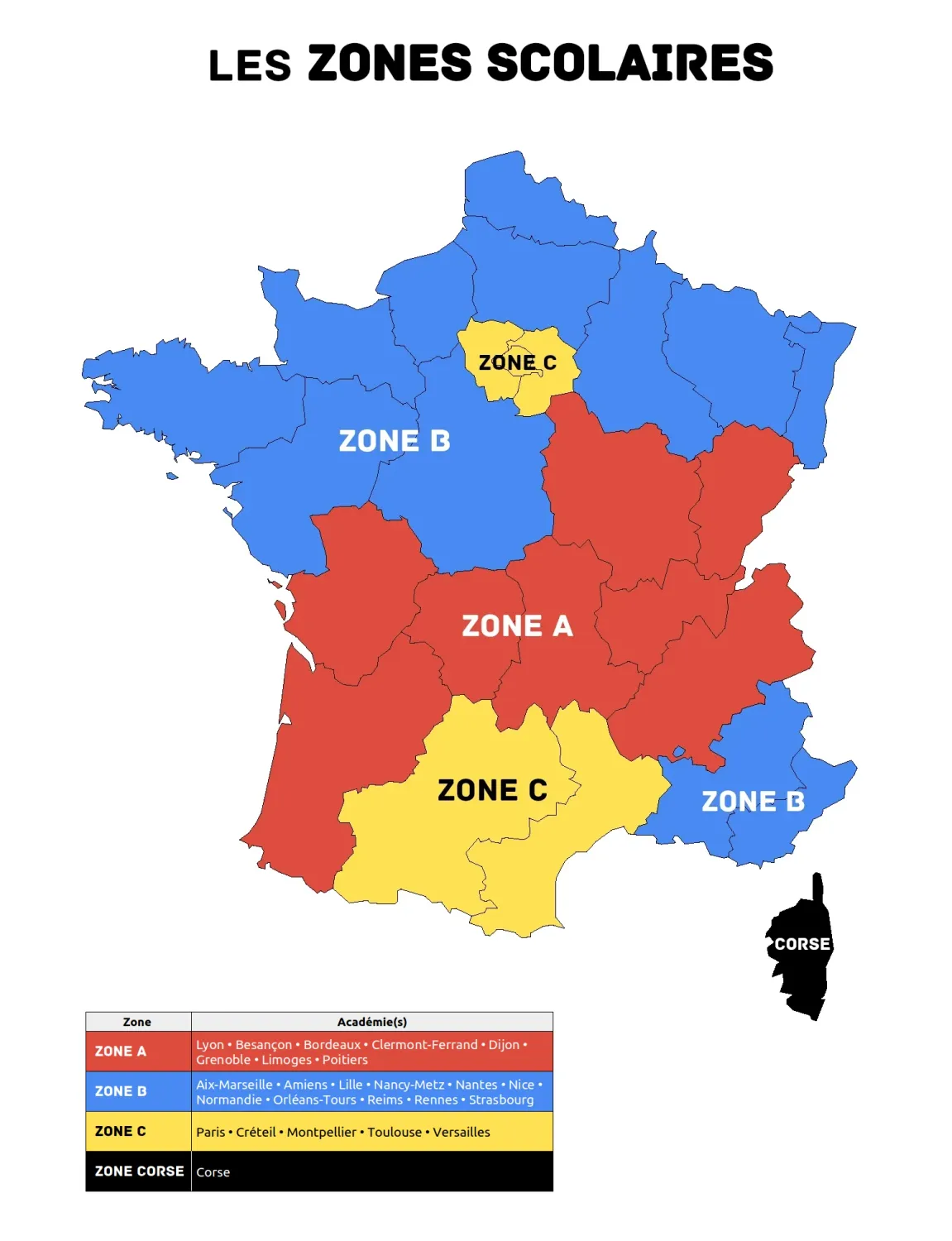
France has a unique system of school holidays (les vacances scolaires) that affects travel, traffic, and daily life. The country is divided into three zones: A, B, and C, each with slightly different dates for certain breaks — especially winter and spring holidays — to help distribute travel and avoid overcrowded resorts.
The goal is to:
reduce traffic
avoid overcrowding in ski resorts and tourist areas
spread out vacation departures (les départs en vacances)
For 2026–2027, here’s an example of the main holidays:
Toussaint (All Saints): ~2 weeks in late October / early November
Christmas / New Year: ~2 weeks around late December / early January
Winter break (Zones A/B/C): ~2 weeks in February / March (dates vary by zone)
Spring break (Zones A/B/C): ~2 weeks in April (dates vary by zone)
Summer holidays: ~2 months from early July to early September
When school holidays begin, train tickets, flights, hotels, and rentals often increase in price. Roads can also become very busy, especially at the start of holidays — a phenomenon known as “les grands départs”.
This system strongly influences French life, travel habits, and even work schedules.
You can find the official French school holiday calendar, including all zones (A, B, and C), here
More than celebrations
All these holidays and traditions show that in France, culture, history, food, and collective life are deeply connected. Celebrations are moments of transmission (la transmission), where stories, habits, and memories are passed from one generation to the next.
Understanding these moments helps you understand France itself — not just the language, but the rhythm of life.
And if you want to learn French while discovering its culture, understand these traditions better, or feel more confident in everyday life in France, you can book a call with me to get started.